Showing posts with label mechanics. Show all posts

Friday, July 26, 2013

The Evolution of Johnny Cueto

It's not hard to argue that the Reds 2012 season was defined, for better and worse, by the health of their starting pitchers. The Reds regular season success was driven by a rotation that was the very picture of health, while the Reds postseason was undone by an untimely injury to Johnny Cueto.

Given the obvious importance of pitcher health to the fortunes of this team, it's worth the time to take a look at the shoulder injuries that have plagued Johnny Cueto. When I first gave thought to Cueto's adoption of a Luis Tiant type coil, I thought it was more of an overnight change. Something he picked up and incorporated prior to the 2012 season. However, if we look at Cueto's position at the apex of the leg kick since he first arrived in the league, it's clear that that's not the case. It was actually a gradual evolution.


Here's a look at Cueto pitching in his first MLB season on August 8, 2008:


As you can see, his leg kick at apex is pretty conventional (and, the quality of the video from 2008 is poor!). He brings his leg up past parallel and has minimal coil. There's very little leg wrap at apex.


Here's Cueto during his second MLB season, pitching in a game on May 24, 2009:


His leg kick in his second season is substantially the same as it was in his first year. Again, he's up past parallel with minimal body coil. And, there's still minimal leg wrap at apex. Note that there is little differential between the line of the hips and the line of the shoulders, both run basically on a line from 2b-to-homeplate.


Here's Johnny in his third season, pitching in a game on August 27, 2010:


Now, you can start to see more body coil at apex. His third year in the majors has brought some mechanical changes, as he has started wrapping his leg at apex. His knee is no longer pointed at third base, but is pointed more towards the third baseman or maybe even the shortstop.

The benefit of the leg wrap is that it creates a differential in the rotation of the hips and the rotation of the shoulders. This differential creates tension in the spine that can increase the force generated by the windup. That differential was not present in his 2008 and 2009 mechanics. So, this version of his mechanics is arguably more efficient, as it potentially generates more force with the body. Force that does not then have to be generated by the arm.

Here he is during his fourth season, pitching on June 9, 2011:


You can, again, see the difference, as he has again changed his mechanics to incorporate even more body coil. His leg is wrapped even farther, pointing almost at second base instead of at the third baseman/shortstop. Despite the increased hip rotation, the differential between the rotation of the shoulders and hips has likely decreased because of the increased rotation of the shoulders. In short, his 2011 set of pitching mechanics is arguably somewhat less efficient than his 2010 mechanics, reducing the potential force generated by the body and, consequently, increasing the force that has to be generated by the pitching arm.


Here's Johnny during his fifth season, working in a game on June 6, 2012:


Finally, in his fifth season, Cueto evolved into his current version. His body coil is now massive. Not only does he have substantial wrapping of the leg, with his knee pointing at second base, but he also uses significantly more shoulder rotation. In 2011, he used a significant degree of leg wrap, but the shoulders stayed in a more traditional position. In 2012, he started rotating his shoulders so far that he showed his back to the hitter. Maybe he wanted to remind the hitters exactly who they were facing. Or, maybe he thought there were benefits to be reaped in deception and gathering his momentum before driving to the plate. Whatever the reason, the transformation was complete.

My initial impression of these pitching mechanics was that they would be very hard on his right knee. The rotating of the hips and upper body against the planted, stationary right leg seemed likely to create significant stress on the right knee. That concern never materialized, but the shoulder problems certainly did.


Finally, here's Johnny during his sixth season, pitching on May 31, 2013:


The mechanics here are essentially the same as the 2012 version.

The interesting thing is that, in one respect, Johnny is right back to where he started: minimal differential between his hip and shoulder rotation. Early in his career, he had limited differential because the line of both his hips and shoulders at apex ran from 2b to homeplate. Now, he has limited differential because the line of both his hips and shoulders at apex runs from 1b to 3b. In one respect, he's gone from "inefficient" (2008 & 2009) to "efficient" (2010 & 2011) and right back to "inefficient" (2012 & 2013).

The only tension created by his current body coil is against the right knee. However, that doesn't provide the same kinetic chain benefits as mechanics that create tension in the spine through a substantial differential, both at apex and after the stride, between hip rotation and shoulder rotation. The latter reduces stress on the arm because it permits a delayed shoulder rotation that results in the pitching arm being pulled through the delivery by the force travelling up through the hip rotation to the spine to the shoulder rotation.

The real problem with using a twisting motion that coils up against the right knee, as Cueto does,  is that it precludes the effective operation of the kinetic chain by forcing the hips and shoulders to move in tandem. If they move in tandem, then they have to uncoil at exactly the same time, making it very difficult to delay the shoulder rotation and thus necessitating that a greater percentage of the force imparted to the baseball be generated by the pitching arm. That could be a reason for the increased arm injuries.

In hindsight, it's obvious that Cueto's body coil wasn't an overnight change, but rather a gradual evolution. His first two seasons (2008 & 2009) involved minimal body coil. He started incorporating more coil in 2010. It got even more severe in 2011 before reaching its current form in 2012 and 2013.

Now that we can see the gradual evolution, the question is whether the Luis Tiant move has resulted in increased performance benefits and/or heightened injury risk. Thanks to the injury history on the brilliant Baseball Prospectus player cards, we can review his specific injury problems.

As anyone who watched the playoffs last year knows, shoulder and back strains are the main problem, so here's a history of his shoulder/back woes:


  • 8/16/2009 -- Right shoulder inflammation, missed 15 days. 
  • 3/22/2011 -- Right shoulder inflammation, missed 47 days. 
  • 9/15/2011 -- Right shoulder strain, latissimus dorsi, missed 14 days.  
  • 10/7/2012 -- Right abdomen strain, oblique, missed 5 days.
  • 4/14/2013 -- Right shoulder strain, latissimus dorsi, missed 36 days.
  • 6/1/2013 -- Right shoulder strain, latissimus dorsi, missed 15 days.
  • 6/29/2013 -- Right shoulder strain, latissimus dorsi, missed an as yet to be determined number of games.


Given that he started incorporating more body coil in 2010, which started getting more severe starting in 2011, it's not inconceivable that his shoulder strains are related to his twisting body coil. The increasing frequency of his shoulder strains certainly seemed to correspond with the increasing severity of his twisting body coil. Causation? Or, merely correlation? Unfortunately, it's impossible to know for sure.

If the injury problems continue, then the Reds have no choice but to make some kind of changes. So, it's worth considering whether his changing mechanics have resulted in improved performance. Here's a look at his peripheral stats over the years:

  • 2008 -- 8.2 K/9, 3.5 BB/9, 38.6 GB%
  • 2009 -- 6.9 K/9, 3.2 BB/9, 41.6 GB%
  • 2010 -- 6.7 K/9, 2.7 BB/9, 41.7 GB%
  • 2011 -- 6.0 K/9, 2.7 BB/9, 53.7 GB%
  • 2012 -- 7.1 K/9, 2.0 BB/9, 48.9 GB%
  • 2013 -- 7.6 K/9, 2.6 BB/9, 51.1 GB%

His performance level throughout his career has been fairly consistent, though it does improve a tick over time. But, is that a result of changing mechanics? Or, just gaining more and more experience at the MLB level?

The biggest area of improvement in his peripherals is the ground ball rate. That seems more likely to be the result of a shift in pitch mix, focusing more on the 2-seamer down in the zone than the 4-seamer up in the zone, than any mechanical change.

At this point, it's difficult to conclude that the twisting body coil is directly tied to his success. My biggest concern would be if the twisting action creates better movement on his pitches. Even so, if the shoulder/back injuries require it, he should be able to alter his mechanics and still maintain a high performance level.

Cueto is an experienced Major League starting pitcher and there's no reason he can't continue to evolve in his pitching mechanics, incorporating a bigger differential between the rotation of the hips and the rotation of the shoulders, to reduce his injury risk. A return to the pitching mechanics of 2010 would likely do the trick. As it stands, his current pitching mechanics undercut the effectiveness of the kinetic chain, requiring his arm to work harder to generate the force for the pitch.

At some point, the Reds season may again come to rest on the right shoulder of Johnny Cueto. Let's hope it proves up to the task. If not, it'll be time for mechanical changes.

Tuesday, June 25, 2013

Swing Mechanics: Joey Votto vs. Eric Hosmer

Joey Votto is one of the best hitters in baseball. Eric Hosmer was reputed to be the next Joey Votto. It hasn't worked out quite that way. One of the main reasons for Hosmer's struggles is his inability to pull the ball with authority.

You can't be a complete hitter without the ability to hit the ball to all fields. On the other hand, you can't be an impact hitter without the ability to pull the ball with authority. A hitter like Tony Gwynn probably comes the closest, but when he used to talk hitting with Ted Williams one of the things Williams encouraged him to do was turn on inside pitches with power rather than keeping his hands inside the ball to flip it to leftfield. For Hosmer to reach his max projection he simply must pull the ball with power.

One theory for Hosmer's struggles with pulling the ball is that he loads his hands too high and too far back. By loading his hands in that way, he increases the distance his hands have to travel to get the bat to the point of contact. In essence, he can get tied up on the inner half because he has increased the length of his swing.

Personally, however, I think the problem has more to do with what happens after the point of contact. To me, the problem with Hosmer is that he has a tendency to not roll his wrists. I simply don't know how you can consistently hook or pull the ball without a strong wrist-roll.

To illustrate Hosmer's problem, here's a look at his swing in comparison with that of former NL MVP Joey Votto.


In this first set of photos below, both Hosmer and Votto are in good position. They have firm front sides, strong hip rotation driving them up onto the toe of the back foot, their back elbows are in close to the back hip to effectively sync up their hip rotation with their arms, and they have their heads down and on the pitch.


Courtesy: Unknown
Courtesy: Unknown


In the second set of photos, they both remain in good position. They have extended out through the point of contact and are now at the point where they need to roll the wrists. After this point, the swings begin to diverge.

Courtesy: Unknown
Courtesy: Unknown


In the third set of photos, differences become readily apparent. Votto begins to roll his wrists, Hosmer does not. Compare the position of Votto's top hand on the bat with that of Hosmer. The back of Votto's hand is clearly visible, while the back of Hosmer's hand is facing the ground. Put differently, Votto's palm is facing the first base dugout, while Hosmer's palm is facing the sky.

Votto has started rolling his wrists, Hosmer has not. Votto's position is incredibly strong, Hosmer's is not.


Courtesy: Unknown
Courtesy: Unknown


In this fourth set of photos, you can further see the difference between the two hitters. Again, compare the positions of the top hand on the bat. Hosmer still has his palm facing the sky, while Votto's palm is facing the ground. Votto has rolled his wrists, Hosmer has not.

In order to accommodate his lack of a wrist-roll, Hosmer has to use a different follow-through. Because Hosmer hasn't rolled his wrists, he has to use a chicken-wing follow-through with his right elbow. Votto's right elbow is pointed to the ground and is in close to his body, while Hosmer's right elbow is pointed at the first base dugout and is at a right angle to his body.

You can also see the obvious difference in the position and angle of their bats. Votto's bat comes around and over, finishing naturally, while Hosmer's bat does not come around and over, rather points towards the sky before finishing somewhat unnaturally. Hosmer's bat simply can't come around his body naturally because his chicken-wing is blocking the way, forcing his bat over-the-top into a more vertical swing path.


Courtesy: Unknown
Courtesy: Unknown


And, in this fifth set of photos, you can see the problem from a different angle. Again, the palm of Hosmer's left hand is facing the sky, while the palm of Votto's left hand is facing the ground. And, again, Hosmer is using the chicken-wing follow-through with his right elbow, whereas Votto's right elbow is pointed to the ground and in close to his body.

Votto has rolled his wrists, while Hosmer has not. Given his hand position in the below photo, it's difficult to imagine Hosmer being able to effectively pull the ball.


Courtesy: Unknown
Courtesy: Unknown


And, in this sixth set of photos, you can again see the difference between the swings, especially in the angle of the bats. Hosmer's points to the sky because he hasn't rolled the wrists, while Votto's bat is more level with the ground. Hosmer's up-and-over swing path simply doesn't lend itself to pulling the ball.


Courtesy: Unknown
Courtesy: Unknown


And, here's one more sequential look at Eric Hosmer's occasionally strange follow-through:


Again, he's not using an effective wrist-roll, instead he's pulling the swing through with a chicken-wing right elbow and letting the top hand come off the bat as the bat points skyward during the swing path. I mean, just focusing purely on his hands, the positions in which he puts them during his follow-through look really uncomfortable. You can also see, based on the flight path of the ball, that's he shooting this ball to the opposite field.

Now, on the plus side, Hosmer doesn't always use this follow-through. I haven't figured out exactly when and why he uses it, though I suspect it happens on inside pitches. It's likely his way of pulling his hands in on inside pitches, but it's certainly not conducive to pulling the ball and is likely the reason why he has stopped hitting home runs.


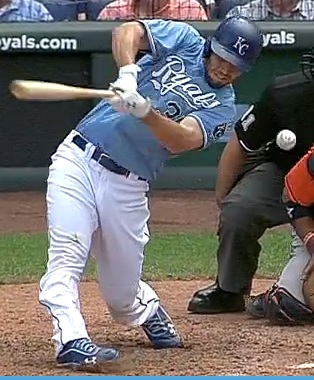
Curiously, on May 30th, the Royals replaced their hitting coaches, Jack Maloof and Andre David, with Hall of Famer George Brett. Now, I'm not sure if Brett has made an immediate, tangible impact (correlation or causation? I don't know), but it can't be denied that Hosmer has once again begun to pull the ball with power. In fact, he pulled two home runs to right field over the last week. Notably, those two home runs were hit with swings that more effectively utilized a wrist-roll.


Here's a screen shot of his homer to right field against the White Sox on June 21st:


If you look at the top hand, then you can see the palm is facing the ground. In addition, the bat angle is flatter, rather than pointing directly towards the sky, and the chicken-wing is gone, as the right elbow is pointed down and is in close to the body. It seems like a swing that ensures better rotation and release, enabling him to pull the ball with power.

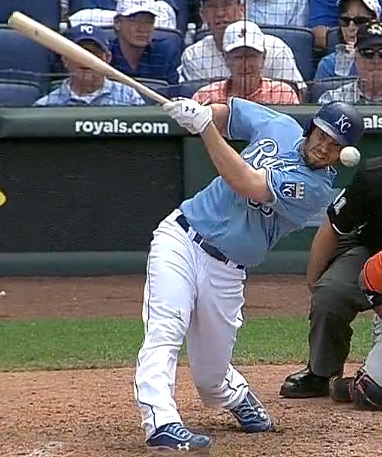
And, to further drive home the point, here's a screen shot of a homer he hit to right field on June 25th, this time against the Braves:


Even more encouraging, his bat angle is even flatter and the palm of the top hand is facing the ground to an even greater degree. His wrist-roll has also eliminated the chicken-wing right elbow follow-through. In fact, the above finishing position looks a great deal like that of Joey Votto in the sixth set of photos. If Hosmer continues to use this wrist action and follow-through, then his offensive production should improve going forward.

Hosmer has the ability and the bat speed to hit the ball with substantial power. Fortunately, it looks like he, possibly with George Brett's help, is getting back to using proper swing mechanics, which should unlock that power, especially to the pull-side, and move him closer to the impact hitter he was projected to be.

The moral of the story, kids, is to always roll your wrists in your follow-through.


Thursday, April 25, 2013

Pitching Mechanics: Tony Cingrani's Rotation Differential


Sometimes a picture is worth a thousand words. That rings especially true when talking about the mechanics of baseball, as a visual frequently drives home a point more effectively than eight paragraphs of labored description.

So, I'll keep this short and sweet. The below Cingrani photo more effectively illustrates one of the key tenets of kinetic-chain pitching mechanics than I ever could.

I've written at length about kinetic-chain pitching mechanics and the benefits they can have on both performance and injury prevention. Part of the reason why I'm so high on Tony Cingrani is his mechanics. Since he's the flavor of the month, it's worth highlighting part of what makes him so effective.

One of the key concepts of kinetic-chain based pitching mechanics is the differential between the rotation of the hips and the rotation of the shoulders. The greater that differential, the greater the ability to generate the force that powers the pitch with the body, instead of the arm.

Here's a look at Cingrani in action against the Marlins:


There is a clear and very substantial differential between the rotation of his hips and the rotation of his shoulders. In this photo, if you were to draw a line through the hips, it would run basically from 1st base to 3rd base. If you were to draw a line through the shoulders, it would run basically from 2nd base to home plate. Basically, his hips are square to homeplate, while his shoulders are square to first base.

The earlier rotation of the hips creates significant tension in the spine. That tension creates energy that moves from the hips to the shoulders to the pitching arm as the spine uncoils. Cingrani's delayed shoulder rotation basically results in the pitching arm being pulled around by the energy of the body, rather than having to rely on the arm itself to generate that energy.

Cingrani's effective use of kinetic-chain mechanics is part of what makes his fastball so effective. And, it should have the added benefit of reducing the risk of arm injury.


Wednesday, February 6, 2013

The Kinetic Chain: Deceleration Phase and Tim Lincecum's Struggles


Courtesy: Unknown
One of the biggest mysteries of the 2012 season was what happened to Tim Lincecum. To date, I haven't heard an adequate explanation, so I've been trying to figure one out for quite some time. The pundits pointed to a decline in velocity as the main reason, opining that he was finally wearing out as a result of his unique pitching mechanics. Of course, a decline in velocity is more symptom than disease. Further, they made it sound like an inevitable and irreversible decline, but I have a hard time accepting that as being true.

Lincecum's mechanics have always made some uneasy, he brought the kinetic chain to the masses. His mechanics demonstrated that you don't have to stand 6-5 with tree trunks for legs to be a legitimate and durable power pitcher. The kinetic chain allowed him to generate substantial force from minimal stature. And, while I've often wondered whether aging might rob him of the flexibility needed to effectively utilize his mechanics, I see no reason why the kinetic chain should falter as he heads into his age 28/29 season. But, if the problem isn't an inherent and inevitable flaw in the principles on which his mechanics were built, then what exactly IS it?

Back in the day, I took a golf lesson from a teaching pro who was very good at what he did. And, part of what he did was to study outcomes and walk them all the way back to identify the swing problem. By focusing on how the results differed from what was intended, he could draw inferences about the nature and extent of the problem. For example, his fellow teaching pros would call him the Divot Doctor, because he would look at the direction and depth of the divot to determine the swing path and angle of attack. From there, he could identify the problem and determine how to correct it. Of course, he could also examine the height, shape, and distance of the shot, along with countless other outcomes of the swing, to identify the problem.

After failing to find a single person who could actually pinpoint the reasons for Lincecum's troubles (granted, Dave Righetti probably [hopefully?] knows, but if so he's not running around espousing those views), I started trying to figure it out on my own. And, starting from the premise that the underlying principles of the kinetic chain remain sound, I started studying the outcomes and trying to walk them back to the underlying mechanical problem. In the end, I think I identified the problem, if not the reason for it.


LINCECUM'S MECHANICAL FLAW?

As mentioned above, the first hue-and-cry to be heard on Lincecum's struggles was that his velocity was down. So, that was the obvious starting point. Was he hurt?

I wondered that until I watched his start on May 9, 2012, which was a typical and telling start. Lincecum's problem in 2012 was "the big inning." For whatever reason, he would frequently fall apart in a single inning, completely derailing any quality work that had come before. It wasn't all bad, all the time, it was more of a high wire act, occasionally impressive but with an inevitable tumble. The only question about his starts was when the tumble would happen. The May 9th game was no different. Lincecum cruised for the first 3 innings, striking out 6, walking 1, inducing one double play ball, and giving up 3 hits and 0 runs. Impressive, no?

Even more impressive than the results was the process. The remarkable thing was that for the first 3 innings, he was crisp. He not only had his velocity back (fastball sitting 92/93/94), but his command was back (painting corners, avoiding middle of plate). Those three innings convinced me that the problem wasn't injury related. The next inning convinced me it was mechanical.

The kinetic chain is about stacking force through a coordinated series of movements and efficiently imparting that force to the baseball. When the kinetic chain is unbroken, the pitcher reaps maximum benefits in performance. The performance of the pitch, whether (1) velocity, (2) movement, or (3) location, will be improved when the chain is unbroken. However, when the kinetic chain breaks, it can impact all three of those components of performance. In the first three innings, Lincecum looked like his old self. In the fourth inning, he looked like a pitcher with a broken chain, complete with decline in velocity and loss of command.

The other constant that I noticed with Lincecum in 2012 was that, during his big inning struggles, he frequently missed up-and-in with the fastball, brushing back right-handed hitters, and bounced his curve ball, uncorking 55-footers way off to the first base side of home plate. Not surprisingly, those pitches both made an appearance in the fourth inning.

In the fourth, his command and velocity were gone, as a result he gave up a double, single, single, and a wild pitch to start things off. His fastball was slower, missing up-and-in, and he bounced 55-foot curveballs. When it was over, he had given up 4 runs, 4 hits, 1 walk, 1 wild pitch, and 1 strikeout.     

How could it all go so wrong, so fast? That's the obvious question. But, the question that was truly puzzling to me was how he could miss up-and-in with the fastball on one pitch, then down-and-away with the curveball on the next? Mistakes up-and-in AND down-and-away? That's the question that bothered me to the core, as the flaws seemed to be polar opposites. After thinking on it (a lot!), I started focusing on the deceleration phase of the delivery.


DECELERATION PHASE OF THE KINETIC CHAIN

I have previously written about the early phases of the kinetic chain, focusing largely on generating force through each sequential move in the chain and then unleashing that force by efficiently imparting it to the baseball. I left out the deceleration phase for a couple of reasons: 1) there is more than enough to chew on with just the generating and imparting phases of the chain, and 2) there is one aspect of the deceleration phase that doesn't make intuitive sense to me.

Notable kinetic chain proponent Trevor Bauer has stated that the deceleration phase includes:

1. The glove side remains firm out front.
2. The throwing shoulder must be closer to the plate than the glove side shoulder.
3. The arm must pronate and the earlier the better.
4. The pitcher needs to continue rotating around the front hip after release.

The one part of the deceleration phase that doesn't make intuitive sense to me is the one that helped me understand Tim Lincecum's problem: number three on the list, pronation of the arm.

The deceleration phase is very important to the health of the pitcher. During a pitch, the shoulder exceeds 7,000 degrees per second of internal rotation for adult pitchers, which is considered the fastest human movement and clearly requires a proper deceleration phase. Obviously, the stress placed on the arm is tremendous, creating substantial injury risk that's only exacerbated by any mechanical flaws in the delivery.

Pronation of the arm is the rotation of the arm such that the surface of the palm is facing downward, which is the opposite of supination. This early rotation of the arm is designed to reduce stress on the elbow. Early pronation (or supination) of the arm dissipates the momentum of the arm more gradually, rather than the momentum slowing down by the banging of the elbow joint. Insufficient pronation (supination) of the arm is the equivalent of slamming on the brakes of the car every time you want to stop. The more often that happens, the sooner the brakes wear out. It's the same with a pitcher's elbow, as you want the pronation/supination of the arm, rather than the elbow joint, to dissipate the momentum.

Ok, so early (i.e. immediately after releasing the ball) rotation of the arm is a big key to proper deceleration, but how does that help us with Lincecum's struggles? Well, in pitching, the arm rotates in different directions depending on the type of pitch thrown. For example, the arm pronates (i.e. rotates counter-clockwise from the perspective of the pitcher) on fastballs, while the arm supinates (i.e. rotates clockwise from the perspective of the pitcher) on curveballs. On the curveball, pitchers either use supination completely throughout the deceleration phase or after their hand passes around the ball to generate the curveball spin their arm then moves back into pronation to decelerate the arm. Lincecum is actually the latter, so he pronates on the curveball as well, but he still starts with supination on his curveball.

Here's a photo of Tim Lincecum throwing a fastball, notice the pronation of the arm upon release:

Courtesy: Unknown


When throwing the curveball, the arm supinates upon release, as demonstrated by the Navy pitcher in the photo below:


Courtesy: Unknown


So, back to my original question:  how could Lincecum miss up-and-in with the fastball on one pitch, then down-and-away with the curveball on the next? How can one flaw result in mistakes up-and-in AND down-and-away?

Well, it seems clear that the above photos set forth the reason for the bouncing curveball and high-and-tight fastball. Lincecum suffered from one flaw, but it was obscured by the difference between pronation (fastballs missing up-and-in) and supination (curveballs bouncing short and to the first base side). Simply put, Tim Lincecum's flaw in 2012 was a slight lag in his pitching arm.

Lincecum was able to pitch well for stretches, but inevitably the kinetic chain would break. If the arm lags behind, then the body's attempt to pull the arm along in the kinetic chain will exacerbate the effect of the pronation/supination of the arm. If the arm lags, then the coordinated movements of the body will be out of sync and the arm won't have the same snap in the delivery. The delivery will be inefficient, reducing the force generated. The shoulder rotation will begin before the arm is up in proper position, as a result the shoulder rotation will be farther along than normal when the pitching hand reaches the release point.

Given that the shoulder rotation was farther along than normal when his pitching hand reached the release point, the rotation would naturally pull the arm towards the first base side. Such an effect would exacerbate the natural pitching arm action, be it supination or pronation.

Consequently, if the shoulder rotation pulled the arm to the first base side on a curveball (supinate), then a bounced pitch to the first base side is the natural result. Further, if the rotation pulled the arm to the first base side on a fastball (pronate), then the natural result would be missing up and in to righthand hitters. In both instances, the pitching arm is unable to catch up to the upper body rotation, but the pitcher holds onto the curveball longer to finish the pitch, whereas the fastball leaves the hand sooner and is pushed up-and-in by the shoulder rotation and lagging pitching arm.

While I think this explanation addresses most of the symptoms of his struggles, the reason why the struggles emerged is much more complicated.


REASON FOR THE FLAW?

The problem that caused his struggles was that his arm lagged behind in his delivery. What I can't determine is the reason for the lag. I have two theories. First, his arm speed was simply diminished. Second, that he, in some way, altered his arm swing, increasing the distance his arm had to travel to reach the release point and causing his arm to lag behind his upper body rotation.

As to the first, if the arm itself slowed down, then it would naturally lag behind the normal tempo of his delivery. If that's the case, then the follow-up question is whether that's reversible or permanent. One interesting aspect of Lincecum's struggles is the weight fluctuation that he has undergone over the last several offseasons. Two offseasons ago, Lincecum felt that added weight, in the form of increased muscle mass, would increase his durability and keep him strong later in the season. Despite a solid season, he wasn't happy with the added weight. As a result, last offseason he committed to dropping the weight. One viable theory is that he dropped too much weight, too quickly and that his strength suffered as a result. That could also explain his inconsistency, as the rapid weight loss could also have affected his stamina and balance. That could be a legitimate reason for a decrease in arm speed. 

If, on the other hand, the arm itself is simply not able to move as fast as did in previous seasons, then arm lag could be a permanent problem. But, in light of the fact that he has shown flashes of his old velocity and the lack of any evidence of injury, it seems unlikely to be permanent.

As to the second, I don't see any indication that his arm-swing has changed. It's possible that it has, but given his flashes of good performance, it seems unlikely. It would seemingly require him to use one type of arm-swing during his good innings and another during his bad ones.


FINAL THOUGHTS

In the end, Lincecum's struggles in the 2012 season seem related to a broken kinetic chain, causing him to lose velocity and command. The chain appeared to break due to a lagging arm, which prevented the shoulder rotation from properly pulling the arm around in the delivery. The tell-tale signs for me were the 55-foot curveball and high-and-tight fastball that popped up in his big innings.

While the reason for the arm lag remain unclear, it seems like the type of problem that can be corrected. Hopefully, an offseason dedicated to rebuilding any lost strength and refining his mechanics can see him return to the pitcher he was prior to the 2012 season. The Cy Young seasons may not be coming back, but there's no reason he can't return to being the top flight pitcher he was in 2010 and 2011. I remain cautiously optimistic that the Freak can return to form in 2013.


Wednesday, January 9, 2013

2013 Top Prospect List: #7 Jesse Winker, of

Courtesy: MILB.com
JESSE WINKER
DOB: 8/17/1993
HEIGHT 6-3, WEIGHT 200, B/T: L/L

If you have followed the Reds for any appreciable amount of time, then the organization's ability to continually restock the farm system is remarkable. The organization's efforts on both the international market and via the draft have been highly successful and a major reason for the organization's MLB success, as they ensures both a steady flow of cost-effective talent for the major league roster and the availability of surplus assets for use in trade. Despite trading away three top prospects last offseason, the organization has yet to even feel their loss, instead continuing to methodically stack the farm system with impact talent.

Jesse Winker is next in line in this flow of talent. Winker is a bat-first player whose offensive upside made him one of the most sought after amateur players in the country and which could, ultimately, make him an impact hitter at the highest level of the sport.  


DRAFT POSITION AND AMATEUR CAREER

The Reds selected Jesse Winker with the 49th over pick in the compensation round of the 2012 draft out of Olympia High School in Florida. The Reds received the pick as compensation for the loss of free agent Ramon Hernandez. Winker joins the growing ranks of Reds players selected from the state of Florida. After landing two top 5 prospects in the first three rounds of the 2011 draft (Stephenson and Cingrani), the Reds land two 6-10 ranked prospects in the 2012 draft (Travieso and Winker). 

At Olympia High School, in his senior season, Winker hit .488 with an OBP of .649, 19 extra-base hits, including 3 homeruns, and 30 RBI in 30 games. Winker also played both ways at Olympia High School, pitching and playing 1b/OF. During his senior season, his primary defensive position was centerfield. Between the summer of 2010 and the summer of 2011, Winker improved his athleticism, transforming his projected professional profile from that of a mediocre defensive 1b/lf into a solid defensive rightfielder with a strong arm. Winker's brother, Joe, also an outfielder, was selected by the Dodgers in the 28th round of the 2011 draft, so baseball is obviously in the family genes.

While talking to the media about the selections of Winker and 57th overall pick Jeff Gelalich, senior director of amateur scouting, Chris Buckley, stated that "Although one is from high school and one is from college, they're kind of similar. They're corner outfielders, advanced hitters, and have solid tools."

For me, one of the more interesting aspects of selecting similar players with back-to-back picks is that both seem to have very good plate discipline, posting very good OBPs in their amateur careers. If both players reach their respective ceilings, then the Reds could have two valuable, disciplined hitters in the organization.

Winker's play in 2012 made him a Rawlings 1st Team All-American. In addition, Winker played on the USA National 18U team that won the gold medal at the 2011 Junior Pan American Games Tournament. A shortage of pitching pressed Winker into service and he was ultimately named the top pitcher at the Junior Pan Am Games.  

Winker has had substantial amateur experience, both national and international, and has performed well at every stop. That experience obviously served him well as he hit the ground running in his professional career in 2012.


2012 SEASON

Winker signed his first professional contract quickly, forgoing his commitment to the University of Florida and giving him time to get his feet wet in the professional ranks. The Reds sent him to the rookie Pioneer League where he logged 62 games for the Billings Mustangs. Winker's advanced approach at the plate proved to be too much for the level of competition.

In 228 ABs, he posted a .338/.443/.500/.943 slash line with a 50/40 K/BB ratio, 16/3/5 2b/3b/HR totals, and 1 stolen base in 4 attempts. He hit line drives at a strong 22% clip, which, while good, probably wasn't enough to support his .410 BABIP, so some regression would be expected.

Winker's performance was strong enough to earn him a spot on the Topps Short Season-A/Rookie All Star team and set him up nicely to likely start out at low-A Dayton in 2013.  


SWING MECHANICS 

Winker stands with a slightly a wider than shoulder-width stance with a small pre-pitch bat waggle. As the pitch is delivered, he utilizes a one piece stride, drawing his foot back and bringing his knee up before striding forward. While the distance covered by the stride is short, the stride itself is lengthy. It operates as a timing mechanism, effectuates his weight transfer, and enables him to cock his hips to generate load in the swing.

When Winker's stride foot lands, he fires his hips, generating power in the swing. Winker's hip rotation is fast, supplying good power to the swing. When his stride foot lands, he firms up his front side, which acts as an anchor around which the force generated by his hips can rotate. He maintains good balance throughout his swing and gets good extension, finishing high with a picturesque one-handed follow-through. Winker makes consistent, hard contact and has the ability to barrel-up the pitch and drive the ball to all fields. His ability ranked him among the very best high school hitters in the 2012 draft class. Despite the strong and efficient lower body action, his initial upper body action arguably works against the generation of force by the lower body.

When his stride foot plants, Winker actually drops his back elbow and brings it forward, a move which is illustrated in photos 1 and 2 below: 


The hitting position in the 2nd photo is somewhat unorthodox, as his upper body leans forward towards the pitcher and the early extension of his hands gives him the appearance of opening up early and coming over the top. A more traditional position is demonstrated in the John Olerud photo below:


Courtesy: Unknown

Of the two, Olerud's position makes it easier to envision him staying back and letting his hips work before the upper body rotates. Winker's swing, on the other hand, involves an earlier upper body rotation, as it's more top-hand driven, likely an attempt to drive the swing with his dominant arm. Whenever I hit a golf ball or a baseball, my swing thought is always one of pulling with the lead hand. Obviously, both baseball and golf swings effectively utilize both hands, but I always get into trouble when I focus on the back hand, as it creates too much "push" in my swing. Winker's heavier top-hand action gives his swing added length in the back and the appearance of some push.

This heavy top-hand action creates a swing that potentially suffers from a measure of "bat-drag", as his back elbow gets out almost ahead of his back-hip. As you can see in the second Winker photo above, one of the consequences of bat-drag is that the front arm straightens out into an arm-bar.  

As a result of Winker's early upper-body move, the differential between the shoulder and hip rotation is greater in the Olerud photo than in the Winker photo for the simple reason that Olerud hasn't opened up his front shoulder. This differential is largely what generates power in the swing. Further, the early top-hand action, and the arm-bar it creates, forces Winker to extend his arms earlier than is ideal, which can act as a drag on the rotational force created by the body.

To date, this top-hand heavy swing hasn't been a hindrance. In fact, he excelled in his first taste of professional ball. So, the other components of his swing may have developed in such a way as to effectively offset the drag on the force created by the lower body action. And, it's important to note that a mechanical issue isn't a flaw until it demonstrably impacts a player's performance level. That hasn't happened yet with Winker, though I wouldn't be surprised if it proved problematic in the future, but for now it's just something worth watching. However, bat-drag has other possible consequences for which he may be less able to compensate.

Bat-drag adds length to the swing, which is likely to move the hitter's contact-point forward. Instead of letting the pitch travel deep, the hitter is frequently forced to make contact with the pitch farther in front of the plate. In addition, bat-drag can impact the timing of the swing, changing when the bat head begins to whip through the zone. As a result, pitchers with better velocity may be able to exploit the longer swing, as the hitter will likely struggle to reach the contact-point in time to meet the pitch. To compensate, the hitter will have to start his swing earlier, which, in return, could make him more susceptible to good offspeed pitches.

Below is a photo of the hand position that potentially creates bat-drag in Winker's swing: 


It'll be interesting to see if Winker's bat-drag causes problems against more advanced competition or if he has built a swing that effectively compensates for this issue. In short, it doesn't matter if his hands get into an unusual position early in the swing just so long as gets them into proper hitting position when needed. Years of repetition and muscle memory may have refined his swing to the point that this is a non-issue. No two hitters swing the bat the same way and potential mechanical issues may never even become detrimental to a hitter. For example, Todd Frazier has an arm-bar swing that only a mother could love, but he tamed his arm-bar to the tune of 19 home runs and a .273 batting average at the MLB level. As the sample size increases and the competition gets tougher, the same may prove true of Jesse Winker.

Here's a look at Winker's swing to see how he gets from the unusual hand-position (top photo) into good hitting position (bottom photo):


In the bottom photo, Winker is in solid hitting position, as he (1) uses a firm front side, (2) has strong hip rotation that generates enough force to drive his back foot up onto the toe, and (3) has his back elbow in fairly good position. In the second photo, the bat angle is pretty steep and the front arm is really straightened in an arm-bar position, extending the hands away from the body. This extension could reduce the ability of the hands and upper body to work in proper sync, creating inefficiency in the swing. All the movement occurring between the first and second photo is hand movement (the upper body maintaining a largely static position until the third photo), which is necessary to compensate for the earlier unorthodox hand position. Regardless of the need for this compensating movement, as long as he can consistently get into good hitting position at the point of contact, then the unusual early hand action will likely prove inconsequential. If, however, it takes him slightly longer to get from the top photo to the bottom photo because of his unusual hand-action, forcing him to move the point of contact forward, then it could prove problematic as he faces more advanced pitching.

Just for comparison sake, here's a photo the best hitter in baseball at a similar point in his swing:


Courtesy: Unknown

In comparison to the second Winker photo above, you can see more flex in Votto's lead arm, the back elbow farther off the hip, a slightly less severe bat angle, and better synchronization between the upper-body and arms.


Part of what could drive Winker's success is strong pitch recognition and an advanced approach to hitting, which when combined enable him to both effectively utilize the entire field and control the strike zone. Getting a good pitch to hit is the most important aspect of hitting and far too few hitters do it well. Winker's selectivity will increase the probability of a successful outcome to his ABs. He should also be able to consistently supplement his batting average with strong on-base percentages, increasing the chances that he'll be a well-rounded, impact hitter at the MLB level.  

If you watch Winker's swing, it's actually very fluid and easy on the eyes. It's only closer study that reveals the usual top-hand action. Still, "unusual" doesn't necessarily equate to "detrimental". And, to date, Winker has had a great deal of success at the plate, so, taken in total, his swing may prove to be effective and productive against even the most advanced competition, though I wouldn't be surprised if he struggles as a direct result of his unusual hand-action.

Here's a look at Winker courtesy Baseball America:


And, here's his draft video, courtesy MLB.com:


Overall, there are a great many things to like about Winker's swing and approach at the plate. Whether the early, unorthodox hand-action creates bat-drag for which he is unable to compensate remains to be seen, but the early professional results do nothing to dispel the high baseline performance level he established for himself in the amateur ranks. 


DEFENSE, POSITIONAL VALUE, AND FINAL THOUGHTS 

The sample size is too small to make any determinations about the quality of Winker's defense, but in some respects he reminds me of a wealthy man's Danny Dorn. I was, and am, a fan of Danny Dorn, so that comparison isn't a criticism, but the cautionary tale I learned from Dorn's career path is that a player who is average (or less) at a defensive position that resides at or near the bottom of the defensive-spectrum REALLY needs to have a special bat to carve out an MLB career. If your defensive value is neutral or negative, then you have to be a highly productive offensive player in order to create enough total value for your team.

Based on early reports, it sounds like Winker may have enough ability to be an average or better rightfielder. If true, that would slightly lessen the need for his bat to carry him to the majors. There are, however, questions about his foot speed and range, which could relegate him to leftfield down the road, reducing his overall value. On the other hand, if he reaches his offensive ceiling AND provides solid defense, then he could become a true impact player at the MLB level.

To date, Winker has done nothing but hit everywhere he's gone. His swing is fundamentally sound, and while he has an unusual component to his swing, it has worked very well for him to this point. Until it doesn't work, there's no real cause for concern. Still, it's worth watching and if he begins to struggle on a consistent basis, then it might be the root of the problem. But, there's a great deal to like about his offensive game (including a disciplined approach that should significantly raise his projected floor) and reason for optimism going forward. For now, he slots in at #7 on the list.

Wednesday, December 12, 2012

2013 Top Prospect List: #5 Didi Gregorius, ss

MARIEKSON "DIDI" GREGORIUS
DOB: 2/18/1990
HEIGHT 6-1, WEIGHT 185, B/T: L/R
Courtesy: MILB.com

Evaluating prospects requires balancing projected ceiling with the probability of reaching it. Didi is a pure probability play. He doesn't have the projected ceiling to be an impact offensive player, but his defense, when coupled with declining performance baselines for MLB shortstops, makes him a high probability prospect. The days of Larkin, Jeter, A-Rod, Nomar, and other well rounded players patrolling the 6 position are over, which once again gives rise to the legitimacy of relying on defensive minded shortstops, like Didi Gregorius. 

The Reds organization has done a tremendous job of rebuilding both their amateur and international scouting capabilities after Marge Schott eviscerated the scouting budget to save a few dollars. Recently, the organization made aggressive, and expensive, international free agent signings of outfielders Yorman Rodriguez and Juan Duran, but they are getting much better returns on the unheralded, and massively less expensive, signings of Johnny Cueto and Didi Gregorius. The Reds signed Didi out of Curacao for a paltry $50,000 back in 2007, a prime example of both the type of value signings that exist only in Latin America and the absolute importance of smaller market teams being active in the international market.

As MLB salaries continue to escalate, the potential return on investment with the Latin America players is just too high to ignore, especially since the newly implemented MLB rules put a cap on signing bonuses for international free agents, ensuring that international signing bonuses won't increase at the same rate as MLB free agent contracts. So, the value of these signings will continue into the foreseeable future. Organizations just to have to use their allocated international budget wisely, selecting the right players to bring into the organization.  

Part of what made Didi intriguing was his athletic bloodlines, as his father and brother both played professional baseball internationally. Didi himself spent some time on the international stage, holding down the shortstop position for the World Cup winning Dutch national team. 

Didi arrived in the organization with little fanfare, but with a solid bundle of skills and abilities that he would soon put on display.  


2012 SEASON

Didi started out the season at double-A Pensacola. For the Blue Wahoos, Didi hit .278/.344/.373/.717 with 11/8/1 2b/3b/HR, 49/29 K/BB ratio, and 3 steals in 7 attempts over 316 ABs and 81 games. He hit line drives at an 18% clip. Didi's performance earned him a promotion to triple-A Louisville.

For the Bats, Didi posted a .243/.288/.427/.715 slash line with 10/3/6 2b/3b/HR, 31/12 K/BB, and 0 steals in 2 attempts. He hit line drives at a 21% clip and impressed the organization enough to earn a late season promotion to the majors.

For the Reds, Didi logged 20 ABs, posting a slash line of .300/.286/.300/.586 with 5 strikeouts against 0 walks. He hit line drives at a 13.3% clip, swung a very aggressive 59.7% of the time, saw only 3.19 pitches per plate appearance, and 41.2% of the pitches at which he swung were outside the strike zone. His time at the big league level was indicative of his aggressive, early-count hitting approach. 

Didi finished out an extended 2012 season with a spin around the Arizona Fall League, posting a .284/.333/.392/.725 with 3/1/1 2b/3b/HR, 4/6 K/BB ratio, and 2 steals in 3 attempts over 74 ABs and 20 games. His performance level was a bit disappointing given that the AFL is such a hitter friendly environment, but it was at the tail end of a long season, so fatigue was likely a factor. 

Throughout his 2012 season, Didi's slash line was fairly consistent, continually exhibiting limited on-base skill and power production.  


SWING MECHANICS

At the plate, Didi utilizes a significantly wider than shoulder-width stance and a vertical bat waggle. As the pitcher sets to deliver, Didi utilizes a two-step stride, drawing his foot back, landing with a toe tap, before striding forward to meet the ball. The first step of the stride triggers a hitch to drop his hands down from up by his left ear and back into hitting position. As he strides forward, he transfers his weight forward, which triggers the swing. Didi gets good extension out through the pitch and uses a two-handed follow-through the finish of his swing, which brings the benefit of increased bat control and balance. Didi maintains good balance throughout his swing, but also doesn't generate that much force that has to be kept under control.

One of the consequence of Didi starting from a wide spread position that gets even wider through his stride is that he struggles to incorporate his lower body into his swing. The obvious problem that creates is in power production, as power in the swing is generated substantially by the core, specifically the rotation of the hips. Didi doesn't effectively cock his hips to generate load for his swing. As a result, he has minimal potential energy stored to unleash through his hip rotation. Further, his foundation is so wide and his swing so driven by the upper body that he doesn't always execute a full and complete weight transfer, seemingly hitting off his back leg like Mark Teixeira (...without the power). His limited hip rotation means he doesn't generate enough force to drive his lower body into proper hitting position by rotating up onto the toe of his back foot. Another issue that occasionally plagues his swing is that he doesn't consistently hit against a firm front leg, rather his front knee has a tendency to leak forward toward the pitcher (a much less extreme version of Dustin Ackley's problem). Instead of a firm front leg, his knee has the occasional tendency to bow out towards the pitcher, making effective hip rotation even more difficult, as this position frequently leads to the hips sliding forward towards the pitcher. Hitters need a firm front leg as an anchor around which the momentum can rotate.

As a result of his inconsistent, inefficient lower body action, Didi fails to both build and unleash force in the swing. This lack of rotational momentum leaves Didi with an underpowered upper body and arm swing.

Here's a look at Didi in action, courtesy of MetsgeekTV on YouTube: 


While Didi struggles to consistently incorporate his lower body into the swing, at times he also seems to extend his arms too early in the swing, further limiting his ability to drive the ball. As a hitter, you want to stay as compact as possible, keeping your hands in close to your body until you fire the swing. The main reason relates to the generation of force, as the rotational energy of the body imparts greater force to the swing if the hands are in closer to the body. The best example as to why was offered up by Chris O'Leary (and it's so good and drives home the point so effectively that I have to give him full credit): spinning figure skaters. If you watch a figure skater spin, they rotate much faster with their arms in close to the body than they do when they extend their arms out away from the body.


Courtesy: Unknown


It's the same principle in hitting, the rotation of the body imparts more force to the swing when the hands are kept in close to the body until extension is needed. If the arms extend too early in the swing, then they slow down the rotation of the body. Didi occasionally gets extended too early, reaching for the ball due in part to limited lower body action, as evidenced in the photo below (note: arms extended too early, slight drift of the front knee towards the pitcher, not rotating up onto the back toe):


Courtesy: Unknown
    
While I have largely focused on the red flags in his swing mechanics, he does have the ability to do it right (see photo below and note: firm front leg, stronger hip rotation improving the drive of the body up onto toe of back foot, though it still happens too late). He's just inconsistent. If he can refine his swing mechanics, then the chances of sustainable success against MLB pitching will improve. If he continues to utilize a largely upper body swing, then he can still be an effective contact hitter. A high contact rate is the key to batting average and typically generates singles at a high rate. And, given his defensive position and skills, a high batting average would be enough to cement his status as an MLB starter. But, he'll need to be able to drive the ball consistently in order to develop into more than just a bottom of the order, glove-first player.


Courtesy: Alan Diaz/AP

While Didi's swing mechanics effectively limit his power, his hitting approach limits his ability to get on-base. At the plate, Didi uses a very aggressive, early-count approach, which limits both strikeouts and walks. A hitter has to see at least 3 pitches in order to strikeout and 4 pitches in order to draw a walk, so any hitter who consistently forces early outcomes to his At Bats will limit both of those outcomes.

The clear problem with this type of approach is that it leaves the hitter with a batting average driven OBP. And, if a player has limited base stealing ability and minimal power, then the early-count approach means the value of his entire offensive game is predicated on an empty batting average.

On the plus side, Didi does exhibit good pitch recognition, allowing him to identify the pitch before making the swing/no-swing decision and reducing the number of times he gets fooled. He also has good hand-eye coordination, enabling him to get the barrel of the bat on the ball and increasing his contact rate. All factors that could enable him to post a solid batting average at the MLB level.

Didi's lack of power precludes him from hitting in the middle third of the order. His limited on-base and stolen base ability will make it difficult for him to be an effective table-setter, though the standards for a second place hitter seem to have fallen over the years. So, Didi will likely hit 2nd, 7th, or 8th, to be determined by the height of his batting average. If Didi can hit for a good average, then his contact skills and batting average driven OBP will slot in nicely in the 2nd spot in the order. If not, then he will bring nothing but an empty batting average to the 7th or 8th slots in the order.  


DEFENSE AND POSITIONAL VALUE 

Gregorius is likely to be a glove-first player for his entire career, a comment on both his offense and his defense. His defensive skills are built on quickness, athleticism, and body control. Gregorius moves very well laterally and has good first step quickness, enabling him to cover a lot of ground. His body control also him to make the acrobatic plays and get to his feet (or whatever position needed) to throw accurately and complete the play.

Didi's best tool is his arm, which allows him to convert a good percentage of those far ranging plays into outs. He can make the plays from deep in the hole because both his arm strength and accuracy are strong. On the downside, Didi still struggles with his hands, as he doesn't cleanly field as many balls as he should. He needs to refine his fielding actions and soften his hands in order to reduce his error totals. Overall, there is a great deal to like about his defensive skills.  

Here is a look at Didi's athleticism, body control, and arm strength, courtesy of MILB.com:   


And, here's another look at his range and body control, courtesy of MLB.com:


Finally, here's a look at Didi's range and arm, courtesy of MLB.com:


Overall, Didi has the tools and skills necessary to be an above average defensive shortstop at the MLB level. I don't see him as being an elite, impact player with the glove (in the Ozzie Smith, Adam Everett mold), but he can legitimately handle the position and could be better than average. For a point of reference, I would rank recent Reds shortstops, based solely on defensive ability, as follows:

Paul Janish > Zack Cozart > Didi Gregorius

All three are, or have the ability to be, above average at the position. For me, Janish is the best combination of range, arm, and hands. Cozart has the best hands, giving him the advantage on the chances he reaches, but falls a tick short of Janish in range and quite a bit short in arm strength. As for Didi, he has good arm strength and range, but not the best hands.

While Didi's value is driven by his defensive tools, he also gets a big boost from the watered down shortstop position at the MLB level. Simply put, there is a real scarcity of legitimate options at the shortstop position. Whether that's merely cyclical, spurred on by new revelations and advances in defensive metrics, or driven by the crack down on IPED usage, shortstop isn't quite the offensive position it used to be. There are still a few impact hitters around, but both the quantity and quality of shortstops seems to be in a down cycle. And, ultimately, scarcity drives value.  


FINAL THOUGHTS

At the beginning of the offseason GM Walt Jocketty proclaimed that the Reds weren't trading Didi. After I had already started working on this write-up, Jocketty wisely changed course and traded Didi. The merits of the trade itself are best left for another post, but it was clear that Didi represented surplus talent. And, smaller market organizations like the Reds, who are in win-now mode, don't have the luxury of surplus assets. If the Reds are going to get over the hump, then they need to throw everything they have into productivity at the MLB level.

It came down to who was the better option for the Reds: Zack Cozart or Didi Gregorius. For me, they chose wisely. Didi is a flashier player, but his limited current offensive production and lack of further projection to his game made Cozart the better choice. Cozart is not only a very capable defender at shortstop, but he also provides solid pop (even if GABP aided), a combination which simply makes him more valuable and reliable than Didi. Cozart's presence and the limited offensive projection to Didi's game made him more valuable to the Reds in trade than between the lines.

In the end, Didi has a chance to be a legitimate MLB starting shortstop, but his position on this list has more to do with positional scarcity than the quality of the aggregate production he is likely to provide. Overall, I much prefer Zach Cozart and have significant questions about Didi's hit tool. That said, despite Didi's limited offensive game, it's difficult to overlook the probability that he will become a multi-season starting shortstop at the MLB level, a fact which lands him at #5 on this list.